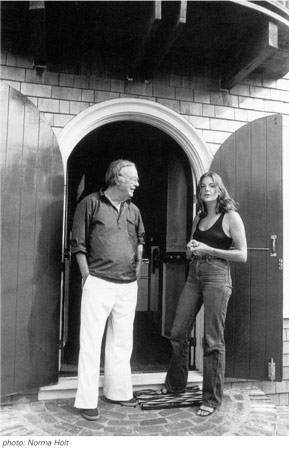
eannie Motherwell spent every summer
of her childhood in Provincetown with
her father, the internationally renowned
painter Robert Motherwell, and her
equally well-known stepmother, Helen
Frankenthaler.
While their parents worked in their studio, Jeannie
and her sister played on the beach with the children
of other artists and writers. “Dad’s theory was that
this was better than camp,” she says. Motherwell
was raised in a world where creativity and psychoanalysis
were part of her daily routine.
“We’d talk about our dreams every morning,” she
says. “Then, Helen and Dad would ask us to write
something and make a drawing out of it. We had no
coloring books; nothing was premade. We were
asked at an early age to think about our thoughts and
emotions.”
A seminal moment in her artistic development
occurred when Motherwell moved to Provincetown
full-time in the late 1970s, when she was in her 20s.
As she was riding her bike through town, a local fisherman
waved and asked her to join him for a drink.
“He pulled a wad of $100 bills from his pocket and
said, ‘I have all this money and I can't give it away,’“
Motherwell remembers. The next day his boat the
Patricia Marie, sank. All that was found was his wallet.
Filled with emotion and a sense of loss to the
community, Motherwell began a series of abstract
paintings and collages of draggers (fishing vessels),
which were bought by both local fishermen and art
collectors.
“It was my first sense of finding my identity in
painting,” she says.
excerpt from an article by Necee Regis, “Sea Change,”
American Airlines American Way magazine, 2005
photo courtesy Provincetown Art Association and Museum |